When to leave our old website, and how to move without the drama

old website

It’s a random Monday morning and a marketing manager at a 20-person company is sitting at their desk thinking it’s going to be a smooth day.
Then they get a note in Slack. It’s from sales. A product’s price has changed. 

Ugh… this is not what they needed right now.
It’s a chore to make an update on their old and slow website. But here we go.

They update it in the inventory system. Then they log into the website and type the same price in again, because the plugin that was supposed to sync the two stopped syncing a while back and nobody noticed.

All done. 10 minutes for 1 line on the website.

Wednesday, a customer emails to say the website shows the old price. 

But how? They just changed it 48 hours ago. Now the blame game is coming for them, and it’s not their fault the plugin is broken. 

On Friday the developer sends a quote to patch the plugin. It’s the third patch this year.

This is a real story and the marketing manager did nothing wrong. The site loads and the forms send. It just fights them every week over broken plugins, old code, and no support. And the bill to keep it all alive keeps arriving.

So when is it time to stop patching an old website and move to something that fits better? And how do you make that move without losing a quarter to it?

Well if you ask me, it’s simple. The time is now and the move can be done in 4 weeks. 

What we are really talking about here is a coding language called PHP. It’s synonymous with WordPress.

PHP runs the lion’s share of the web. W3Techs says it’s “used by 69.0% of all the websites whose server-side programming language we know.” Plenty of PHP sites are current and well looked after.

The trouble I’m talking about is an old PHP site nobody has a plan for: an aging version, a pile of plugins, and custom code written years ago by someone who’s long gone.


Why now?


Just last month, October, the PHP project shipped fixes for two critical flaws known as php2shell. It rated both 9.2 out of 10 on the CVSS 4.0 scale, and the National Vulnerability Database’s own CVSS 3.1 scores are 9.8 and 8.1. 

Those are serious issues.

On Oct 26, the U.S. Cybersecurity and Infrastructure Security Agency (CISA) added both to its list of flaws attackers are actively using.

The fixes only exist for PHP 8.2 and newer. For older sites, CISA’s alert was blunt: 


Systems that “continue to use PHP 8.1 or earlier unsupported versions, should take PHP-based systems offline until they can be patched or updated.” 

If your site is on 8.1 or older, fix that this week!

Whew! Glad you got that fixed. 

Right now, you might be feeling like Indiana Jones after he swapped out the idol with the sandbag. 

I sure hope that’s the only trouble you… WAIT! A giant boulder is on the loose!

The boulder here is that PHP 8.2 stops getting security fixes on Dec 31, 2026.

But you just updated. Now what do you do?

WordPress.org’s own stats, captured Nov 9, show 32.3% of WordPress sites on PHP 8.1 or older and another 22.6% on 8.2.

Thats one third of the internet.

None of that forces you off PHP though. A well supported, patched version fixes it. What October did was put a decision on every old PHP site. Since you’re deciding anyway, ask the bigger question too.


When I’d stay and upgrade


Stay put if most of this describes your site:

  • It can move to PHP 8.3 or newer without rewriting custom code. WordPress recommends “PHP version 8.3 or greater.”
  • Your plugins still get regular updates from the people who make them.
  • Your team enters each piece of content once, in one place.
  • Upkeep costs about the same each year, with few surprise invoices.
  • You can name the person who owns the next update.

If that’s you, upgrade. Test it on a staging site first (a private copy where things can break without customers seeing it), then get back to work. It’s the smallest move, and for a healthy site it’s usually the right one.


When I’d start looking at greener pastures


No study draws this line for you. 

What follows is my judgment. I put it this way on LinkedIn earlier this month: sometimes a site is so tangled in old plugins that moving it off PHP costs less than babysitting it.

  • The custom code is stuck on an old version. If the site can’t get past 8.1 without a rewrite, you’re already paying for a rewrite. You’re paying for it in pieces, every time something breaks.
  • Plugins are holding the business together. When a handful of plugins carry your orders, leads, and pricing, and your team types the same data into two systems, the site costs you hours every week. Those hours never show up on the hosting invoice.
  • Upkeep keeps climbing. Add up last year’s patches, plugin licenses, emergency fixes, and the time your team spent working around the site. If that total goes up every year, put a rebuild quote next to it and compare.
  • Nobody wants to touch it. Ask your developer how hard it would be to hand your codebase to someone new.
  • It won’t connect to anything. If you want the site talking to your CRM, your inventory system, or an AI tool, and every connection means another plugin or a custom workaround, the stack is in your way.

One of these on its own is a reason to clean up. Three or four together is when I’d price a move.


What greener pastures looks like


Greener pastures come down to fit. 

If this was my site, these are the non-negotiables I want:

  • Data lives in one place. 
  • A price changes once and shows up everywhere it should. 
  • The jobs you bolted plugins on for are either built in or handled by one service you trust. 
  • The platform under it has years of support left, and someone owns the update schedule. 
  • Changes go through a staging copy and get tested before customers see them. 

My website would also connect to other tools through real integrations, so adding an AI tool or a new system later is a normal project.


For marketing sites, our standard rebuild is Next.js. It’s modern and builds fast web pages. We pair that front end with PaigeBuilder as the editor your team uses to change pages without a ticket. Easy peasy.

These sites run on the cloud account you already pay for, such as AWS, Google Cloud, or Azure. Custom apps and portals get React on the front and Node or Python behind it. 

For online stores, Shopify works when your needs fit what Shopify does, and a custom commerce build makes sense once the store has outgrown what Shopify allows. The right answer depends on what the site has to do for your business.


How to move without the drama


Migration drama comes from surprises. Most of the work is digging the surprises out early.

  1. Take inventory. List every page, form, plugin, integration, and report, plus who uses each one and why. This is where you find the plugin that quietly sends leads to sales.
  2. Decide what moves. Some features get rebuilt, some get replaced by a service, and some get retired. Map every old web address to its new home so search traffic and bookmarks follow you.
  3. Run both in parallel. Build the new site next to the old one, which stays live the whole time. Move the content, connect the integrations, and test real tasks: submit the forms, place a test order, change a price.
  4. Cut over. Pick a quiet window, switch traffic to the new site, and watch it closely for the first few days. Keep the old site and a full backup ready so you can roll back if something’s off.
  5. Shut down the old site once nothing depends on it anymore.

For the marketing manager in the opening, here’s what that buys her: she changes the price once, on Monday, and it’s right everywhere.


Where to start


Ask your host or developer one question: what PHP version are we on, and what’s the plan before Dec 31?

If the answer is a quick upgrade, great. If it comes back with a list of plugins, workarounds, and “we’d have to rewrite that part,” grab 30 minutes with me. We’ll work out together whether you upgrade, rebuild, or move, and what each path costs you over the next few years.


More articles in our blog.


The most expensive decision is the one you push to January

expensive decision

Last November I sat with the leadership of a 45-person law firm, 5 offices across two states, and we agreed on a project they’d been circling for most of the year. We wrote the scope and settled the price, and by the end of the meeting everyone at the table wanted to move forward. Then one of the partners said what someone always says in November: “Let’s pick this back up after the new year.”

Nobody argued with him, and I understand why. The budget wasn’t final, it was the busiest stretch of their year, and January sounded like a cleaner place to start. But when January came the conversation started over from scratch, and it started over again in April. It’s now October, nearly a year later, and the firm hasn’t started. Their people are still doing the same work by hand that they were doing when we met, and the firm is further behind than it was then.

Nobody at that firm ever said no. That’s the part I keep coming back to, because the cost of the delay has been running every week for a year without anyone choosing to pay it.

I’m watching the same thing set up again this fall. Of the 14 open conversations in our pipeline right now, 8 have a Q1 start that depends on a budget nobody has signed.

After enough years of this, I’ve come to think Q4 is the best decision window a business gets, and that most businesses let it close without noticing.


What October gives you that February won’t


The first thing October gives you is a full year of evidence. You know which process broke in March and which team spent the summer working nights to cover for it, and you probably have a complaint or two that showed up every month like rent. That knowledge is sharp right now. By February, whatever caught fire over the holidays has pushed it out of focus.

The second is a budget that’s still wet ink. Most companies run their fiscal year on the calendar, so next year’s numbers are being argued over this month. When Gartner wanted to know what CFOs planned to spend in 2026, it surveyed them in October 2025, and 75% said their tech budgets were going up (Gartner). By January, finance has locked those line items, and teams usually wait until a mid-year reforecast to add anything they left out.

The third is a January calendar with nothing on it yet. Q1 fills up fast with hiring and sales targets and the kickoffs that did get approved, and a project that doesn’t have a start date by mid-December tends to end up fighting for whatever attention is left over in March.


Why “let’s revisit” feels so safe


Postponing a decision doesn’t feel like making one. Your team lets the delay pass without blame, and the business carries on as usual that afternoon. That’s why postponing feels so easy.

The research on how organizations decide is pretty unflattering. In a McKinsey survey of more than 1,200 executives, managers reported spending 37% of their working time on decisions, and they rated well over half of that time as poorly used (McKinsey).

The finding that stuck with me most comes from Matt Dixon, who studied roughly 2.5 million recorded sales conversations. Somewhere between 40% and 60% of the deals he looked at ended with the buyer doing nothing at all. You’d assume those buyers were happy with the way things were, but less than half of them were. Most of the rest were stuck because they were, in his words, “worried about making a big mistake” (CustomerThink).

I’d guess that describes the law firm pretty well. I doubt anyone there loved the old process. What stopped them was fear of picking the wrong fix, so they picked nothing, and nothing turned out to be the most expensive option on the table.


expensive decision


Putting a number on the wait


Say a fix would give 5 people back 6 hours a week each, so 30 hours a week in total. The Bureau of Labor Statistics puts the average loaded cost of a private-sector employee at $46.89 an hour (BLS).

If that project starts in April instead of January, the 12 weeks in between cost you about $16,880 (30 × $46.89 × 12). If it slips a full year the way the law firm’s did, you’re closer to $73,000 (30 × $46.89 × 52).

I’d call both of those numbers low. The BLS figure averages every private job in the country, and the paralegals, bookkeepers and ops people who end up retyping data usually cost more than that. The math also leaves out the costs that don’t show up on a timesheet, like a client who waited too long for an answer or an employee who quit because half their week was copy and paste.


The AI version is worse


Indecision costs more when the thing you’re putting off is AI, because the companies that already decided are compounding what they learn. McKinsey’s 2026 State of AI survey found that 88% of organizations now use AI regularly somewhere in the business, yet only 37% can point to any effect on earnings (McKinsey).

When I talk to companies on the wrong side of that gap, the cause usually traces back to a pilot that started before anyone agreed on what it was for or how they’d know it was working. When teams skip the upfront decision, they can end up with a project a few months later that no one can defend at budget time.

The most common reasons I hear for waiting sound sensible enough. One is that AI is changing too fast to commit to anything, which is true, and it’ll still be true next October. Another is that the data isn’t ready. It almost never is; Gartner found 63% of organizations either lack the data practices AI needs or aren’t sure whether they have them (Gartner). Messy data is a good reason to scope the first project carefully, and a bad reason to lose a year. The third, and the one that worries me most, is “we’ll have more clarity in January,” when January is the month you’ll have the least room to act on it.


Making the decision small enough to make


What helped the clients who did get moving was shrinking the decision until it was small enough to say yes to. What gets approved in December is one workflow, with one person who owns it and a date on the calendar.

So in the next few weeks, pick the process that ate the most hours this year and write down what it costs you now, in hours and dollars and customer wait time. By late November you should know roughly what a fix would cost to build and run and when it pays for itself, which is what your CFO or controller will ask about first. Get it in as a line item in early December, aim for approval before the holidays, and you can start the first week of January.

Most first projects are reversible. If the workflow you pick turns out to be the wrong one, you’ll find out in a few weeks and adjust, and you’ll have learned something. Waiting a year costs you time you can’t recover.

The law firm will probably start eventually, but they’ve already paid for a year of the problem, and they never got to decide whether it was worth it.


If you want help figuring out which workflow to start with, grab 30 minutes on my calendar. And if you know someone building next year’s budget right now, send this their way.

Take a look at our blog.

Proximity Is the Moat

proximity

By Brian Hammond, VP of Sales, FYC Labs


On the first morning of the Pro Padel League season opener in New York, an umpire missed both serves and had nowhere to put it.

Our scorekeeping app had buttons for everything the spec called for. It did not have a button for a double fault, because in the rules a double fault is a consequence of two other things rather than an event of its own. Reasonable on paper. Useless at a live match with a crowd watching and a broadcast running.

Graham was standing three feet from the umpire when it happened. He posted it. Aaron, sitting at home in California Arizona, worked out that the app could infer a double fault from the point outcome. Fixed within minutes, live, mid-match.

No requirements document would have surfaced that. No discovery call would have surfaced it either. It took someone physically standing next to a person doing the job.


How the deal started


Pro Padel League came to us as a website build with some backend work behind it. Team management, player profiles, stat tracking. A five figure project, scoped and sold entirely over video calls. Clear requirements, good client, the kind of engagement that runs clean.

Then we went to their event.

PPL’s season opener ran at the Hammerstein Ballroom while PPL II, their second division, ran simultaneously across the river at Padel Haus. We split the team across both venues and kept a war room open all day, every day, connecting the people on site to the people at home.


Here’s a partial list of what got built during the tournament, none of which existed in the scope of work:


  • Live standings. The website was rendering standings statically, which meant a redeploy every time a match ended. We rewrote it to run live because a three minute deploy is an eternity when someone’s checking the site between points.
  • A disqualification system. Mid-tournament, a team pulled out to go play another event and got disqualified. Nobody scopes for that. Justin built a disqualification property on the team record that propagates a “DQ” tag to the broadcast graphics and the website automatically. Shipped the same day it happened.
  • Direct score bug editing. When live data and human error collided, we needed a way to correct the on-screen graphic without unwinding the whole match record. Built on the floor.
  • Sponsor scenes. PPL signed brand deals that carried on-screen obligations, including a countdown scene for their official timekeeper and a shot accuracy scene for a tech partner. Our score bug became the delivery mechanism for their sponsorship revenue.
  • A rebuilt umpire experience, driven almost entirely by notes taken while watching umpires work under pressure.

Three hotfixes went out before lunch on day one. Justin was still syncing score and stat data at 1:25 in the morning. The umpires loved the app, and told us exactly what was wrong with it, which is the most valuable feedback in the world and completely unavailable over email.

The discovery call is a sales meeting


Everything above came out of proximity, and it’s worth being precise about why.

A meeting labeled “discovery” is a sales meeting, and both sides know it. The client brings a version of their problem they’ve already polished for outside consumption. We bring our best demonstration of competence. Guards go up, politely, and stay up.

What gets discussed is the problem the client has already named for themselves. The problems worth real money usually don’t have names yet. They’re the workarounds people stopped noticing, the thing that breaks at every event and gets fixed by hand because that’s just how it goes.

Nobody writes that in a requirements doc. From the inside it doesn’t read as a problem. It reads as Tuesday.

Guards come down somewhere else: at the event, in the war room at hour nine, at the bar afterward, in the hallway when something is on fire and you’re the one helping put it out. That’s where you find out what the work actually is.

Remote is how it got built


None of this is an argument against distributed teams, and our own week proves it.

Justin, Graham and I were in New York. Aaron, Kevin, Zach and Brianne were at home, three time zones back, in a Google Meet that stayed open for eight hours at a stretch. Kevin diagnosed a broadcast graphics issue through a power outage at his house. The double fault fix came from a guy in California who was not in the building.

The split was the point. People in the room to see the problem, people at home with the focus to solve it, and a live connection between them.

Writing software remotely is a solved problem. Figuring out which software to write is a different job, and that one still rewards being there. Trust works the same way. It builds slowly over video and quickly at 1am when you’re both trying to get the scoreboard back up before the next match starts.


What the first half of 2026 showed us


About a third of the deals we closed in H1 involved at least one in-person conversation somewhere in the process.

Those deals are disproportionately our largest, and more to the point, they’re the ones that grew after signing. Our purely virtual engagements tend to land exactly as scoped. Good projects, delivered well, closed out on time. The in-person ones expand, because somebody saw something.

PPL is now a multi-year operation, and we’re on site for every remaining stop of the 2026 season. The umpire and scorekeeping system we rebuilt on that floor is something we’re now looking at as a product for padel clubs and organizations that need to run their own scoring. And a production partner we worked alongside at the event has opened a conversation with us about work well outside of padel entirely.

A five figure website build turned into an operation with revenue lines nobody wrote down.

The pattern holds on the referral side too. Our strongest partner relationships are the ones where we see each other in person on a regular basis, with no agenda attached. Evelyn Milani at Avanti Recruiters has sent four introductions our way and three became clients, which works because we talk often enough that FYC is on her mind when something relevant crosses her desk.


What we’re doing about it


More rooms.

We’re at frAIdays at Granite City, also showing up for SVP events. We’re collaborated with Connect2Change.

And we’re at every remaining stop on the PPL calendar. Los Angeles at the Barker Hangar on August 13, then Playa del Carmen in September, Guadalajara in November, Miami in December. Four more chances to stand next to somebody doing the job and find out what we got wrong.

It’s a bet that the highest leverage thing a services business can do is be physically present while the work is happening, because that’s when the real problem shows itself.

If there’s a client in your world sitting on something a discovery call would never surface, the fix is usually a room, a day, and someone paying attention.


Connect with us on LinkedIn or check out our blog.

Is This the EOL for SaaS?

SaaS

For years, SaaS defined how companies operated.

If you needed a CRM, you picked one.
If you needed automation, you subscribed.
If you needed reporting, you stacked another tool on top.

It worked. Until it didn’t.

Because somewhere along the way, teams stopped building systems that fit how they actually operate… and started forcing their operations to fit the software they bought.

That’s where the shift is happening.


The Era of Off-the-Shelf SaaS is Ending


Generic SaaS isn’t disappearing overnight, but its limitations are becoming impossible to ignore.

Most tools were designed to serve everyone – which means they rarely serve a single team’s workflow end-to-end. You get close enough functionality, then spend the rest of your time adapting your processes around the tool’s constraints.

More dashboards. More tabs. More workarounds. More friction.

The result is a stack that looks powerful on paper, but behaves like fragmentation in practice.


SaaS isn’t dead – but “one-size-fits-all” is.

The real change isn’t about software disappearing. It’s about expectation shifting.

Teams no longer want:

  • restrictive workflows they can’t change
  • disconnected tools that don’t talk to each other
  • subscription stacks that grow but don’t align
  • platforms that dictate how work gets done

Instead, teams want systems that reflect how they actually operate. Because “good enough” software eventually becomes expensive software – not in price, but in lost efficiency, duplicated effort, and broken visibility.


From SaaS to Built-for-you Systems


The companies pulling ahead aren’t just using tools anymore – they’re building systems. Not for the sake of complexity, but for alignment.

Instead of asking “Which SaaS tool do we use?” the question becomes: “What does our system need to do?”

That shift changes everything.

  • Tools become components, not restrictions
  • Workflows become designed, not adopted
  • Data becomes connected, not fragmented
  • Execution becomes intentional, not fixing as you go

This is the move from SaaS dependency to system ownership.

In simple words: don’t rent your stack – own it.


Where FYC Labs Fits In


At FYC Labs, we build beyond software. We don’t just implement tools – we develop our own systems where existing SaaS hits its ceiling.

That means designing and building custom infrastructure across marketing, product, and operations that actually reflects how teams work, not how software assumes they work.

Instead of stitching together disconnected platforms, we create unified systems where:

  • data flows cleanly between stages
  • automation runs without manual disconnected setup
  • tracking and execution live in one structure
  • teams operate from clarity instead of complexity

In some cases, that means extending SaaS tools. In others, it means replacing them entirely. And continuously, it means building custom tools designed for a specific business reality. Because the goal isn’t more software. It’s less friction, more control, and systems that actually fit.

Stop forcing your business to fit inside disconnected tools. We design and build custom systems that replace friction with structure – connecting your marketing, operations, and data into one unified setup that actually reflects how your team works.


Don’t subscribe. Build.


The shift is simple but important: generic SaaS is fading. Custom-built systems are taking its place. Not because SaaS failed, but because businesses evolved past what generic tools can deliver.

The future isn’t about choosing between tools. It’s about building the system those tools were never designed to become. And the companies that understand that first won’t just work faster – they’ll operate differently entirely.

At FYC Labs, we don’t just help you “use SaaS better.” We build beyond it – creating tailored systems, automation, and infrastructure that give you control, clarity, and consistency across execution.

If your stack is starting to feel fragmented, we can fix that.


Stop buying software. Start building what you need.

The 3 Conversations Every Operator is Having About Software Right Now

The 3 Conversations

We’ve been keeping a list.

For six months, every conversation we’ve had with a founder or operator about software has landed in one of three buckets. Every one of them. Charter school directors, Shopify merchants, SaaS founders, regional services CEOs. Same three conversations. Once you can name them, you stop missing the referrals sitting in your inbox.

A bit of context first.


The software market split in February:


  • Anthropic shipped Claude Cowork and roughly $285 billion in SaaS market cap evaporated in 48 hours.
  • Atlassian reported its first enterprise seat decline ever and cut 10% of its workforce. 
  • Freshworks laid off 11% on May 5 and the CEO publicly blamed AI.
  • Retool surveyed 817 builders and found 35% had already replaced at least one SaaS tool with a custom build.
  • Lovable, meanwhile, hit 8 million users and 100,000 new projects per day, then had three security incidents in 13 months.


Every founder, operator, and CMO you talk to has felt this shift. Some are riding it. Some are scrambling to recover from it. Some are watching it pass them by.

Which means they’re in one of three conversations.


Conversation 1: Rescue


A founder built something themselves. Lovable, Bolt, Cursor, Replit, Claude Code. It works on a demo. They showed it to investors, to their team, to a customer. Now they’re trying to put it in production and the wheels are coming off.

The phrases sound like this. “It works on my laptop but breaks when more than five people use it.” “We pushed the AI to add one more feature and now nothing works.” “We have no idea what this code actually does.” “Our Stripe keys are in the front-end and we just had charges we can’t explain.”

The data is brutal. Veracode’s 2025 GenAI Code Security Report found 45% of AI-generated code samples contain OWASP Top 10 vulnerabilities. A Q1 2026 audit of 200+ vibe-coded apps found 91.5% had at least one AI-hallucination flaw, and more than 60% exposed API keys or database credentials in public repos. Aikido Security now attributes one in five enterprise security breaches directly to AI-generated code.

The tone is defensive, sometimes embarrassed, usually urgent. The founder validated the idea. Making it real is somebody else’s problem now.

A line that lands: “You proved the idea works. The hard part is the next 20%.”


Conversation 2: Replace


The operator is fed up with SaaS.

Their Mailchimp bill keeps going up. Their CRM doesn’t fit how they sell. They’ve got 14 tools that don’t talk to each other. Their team uses 10% of what they’re paying for. Their niche vendor got acquired and the product is going to hell.

Retool’s 2026 Build vs. Buy Shift report quoted Miles Konstantin at Harmonic: “Their support was so slow that it was faster for me to rebuild the product inside Retool than wait for support to get back to me.” Harmonic now runs 33 internal apps replacing third-party tools.

That story isn’t isolated. 78% of Retool’s surveyed builders expect to build more custom internal tools in 2026. 60% have built software outside IT oversight in the past year.

There’s a contrarian view worth knowing. Jason Lemkin at SaaStr argues the SaaSpocalypse is mostly the unwinding of 2021 over-hiring and over-valuation, not AI killing SaaS. Sarah Tavel pointed out that nobody is actually rebuilding Salesforce in Replit. They both have a point.

Nobody is rebuilding their ERP. But the niche tools, the workflow automations, the per-seat admin software? That wave is already moving.

The tone is calm and frustrated. The operator has done the math. They’ve decided to build. The only question is who builds it with them.

A line that lands: “You’re not buying software anymore. You’re buying ownership.”


Conversation 3: Catch-Up


A CEO knows their competitors automated something six months ago. They watched their margin compress. They got a deck from an AI consultant. They tried to hire an AI engineer and got crushed by the salary. They bought Agentforce or Copilot or Breeze and nobody on their team is using it.

The pressure is real. The 2026 SMB AI Outlook reports 57% of US small businesses are now investing in AI tech, up from 36% in 2023. McKinsey estimates agentic AI could unlock $2.9 trillion in productivity by 2030. Founders read these numbers and feel them on their P&L.

Agents are an integration problem dressed up as an AI problem. Gartner found in May 2026 that 80% of companies that reduced workforce via AI saw no correlation with higher ROI. Klarna publicly reversed parts of its AI-first customer service strategy after agents couldn’t handle complex cases. Every operator who said “we’ll just use AI” without fixing their data, their CRM, and their integration plumbing is now quietly rehiring.

The tone is anxious and vision-driven. They want to be ahead. They’ve spent money on the wrong things. They need someone who can connect the systems they already have so the AI they want can act on something real.

A line that lands: “The AI isn’t the hard part. The plumbing is.”


What to do when you hear one


Naming the conversation back to the person is more useful than pitching software.

For rescue: “You proved the idea. The hard part is the next 20%.”

For replace: “You’re not buying software anymore. You’re buying ownership.”

For catch-up: “The AI isn’t the hard part. The plumbing is.”

Do that and you’ve already done more useful work for them than 90% of the AI consultants they’re paying.

If they ask who builds the real thing, send them to us. FYC Labs has been doing custom software for 12 years. Most of our work right now comes through partners who learned to listen for these three.


We’ll take it from there.

by Brian Hammond (VP of Sales, FYC Labs)


More for FYC Labs

How to Pitch AI to Skeptical Clients (Without Sounding Like a LinkedIn Influencer)

by Brian Hammond (VP of Sales, FYC Labs)


You’ve heard it. Maybe this week.

“We’re not really an AI company.”

“Sounds expensive.”

“Isn’t that just ChatGPT?”


Your client isn’t wrong to be skeptical. They’ve been pitched AI by every SaaS vendor with a marketing budget since 2023. Most of those pitches were vague, buzzy, and disconnected from anything resembling their actual workday.


So when you bring up AI, you’re fighting through a wall of noise they didn’t build. You just have to walk through it.

The good news: skepticism about AI isn’t a closed door. It’s a sign that nobody’s bothered to make it concrete for them yet. That’s where you come in.

Here’s a 5-step framework you can use in your next client conversation. No slides required. No technical background needed. Just a few good questions and a willingness to listen for the right signals.
 

pitch ai


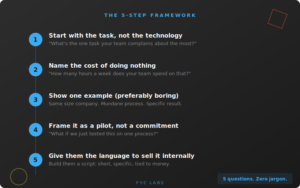
Step 1: Start With the Task, Not the Technology


The fastest way to lose a skeptical client is to lead with AI. Lead with their pain instead.

One question does most of the work here:

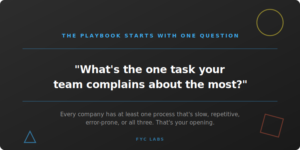
“What’s the one task your team complains about the most?”


That’s it. You’re not selling AI yet. You’re doing discovery. Every company has at least one process that’s slow, repetitive, error-prone, or all three. Data entry. Invoice matching. Sorting through intake forms. Pulling numbers from 4 systems into 1 report every Monday morning.

When they answer, you’ll hear the frustration in their voice. That frustration is your opening.


A few variations that work just as well:

  • “If you could eliminate one bottleneck tomorrow, what would it be?”
  • “Where do your best people spend time on work that doesn’t need them?”
  • “What breaks first when your team gets busy?”

You’re listening for tasks that are repetitive, rule-based, and high-volume. Those are the ones AI chews through.


Step 2: Name the Cost of Doing Nothing
 

pitch ai


Skeptical clients aren’t weighing “AI vs. no AI.” They’re weighing “spend money on something I don’t fully understand vs. keep doing what we’re doing.” The status quo feels safe because nobody gets fired for leaving things the way they are.


Your job is to make the status quo feel expensive.

Once they’ve named the painful task, put a number on it. You don’t need to be precise. Rough math is more persuasive than no math.

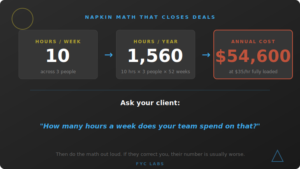
“How many hours a week does your team spend on that?”

Then do the arithmetic out loud. 10 hours a week across 3 people is 1,560 hours a year. At $35/hour fully loaded, that’s $54,600 spent on work that a well-built system could handle in minutes. Every year. Compounding.


You’re not quoting an AI project. You’re showing them what they’re already paying for the privilege of staying manual.

If they push back on the numbers, let them correct you. Their version is usually worse than yours.


Step 3: Show One Example (Preferably Boring)


The best AI pitch isn’t impressive. It’s relatable.

Skip the generative art demos. Skip the chatbot that writes poetry. Show them something that looks like their Tuesday afternoon.

“We built a tool for a [similar company] that reads incoming PDF invoices, pulls out the line items, and drops them into their accounting system. Their AP team used to spend 6 hours a day on that. Now it takes 20 minutes of review.”


The example should be:

  • From a company they’d recognize as similar to theirs. Same size, same industry, same level of technical sophistication. If you’re talking to a 40-person landscaping company, don’t show them what a fintech startup built.
  • Mundane enough to be believable. Flashy demos create distance. Boring demos create trust. The client should think “oh, we have that exact problem.”
  • Specific enough to stick. Hours saved. Steps eliminated. Errors reduced. Give them a number they can repeat to their business partner over lunch.

If you don’t have a perfect case study, that’s fine. Describe the pattern: “Companies your size usually see the biggest wins when they automate [the thing they just told you about in Step 1].”


Step 4: Frame It as a Pilot, Not a Commitment


The word “implementation” makes skeptical clients tense up. It sounds like a 6-month project with a committee and a Gantt chart.

Instead, frame the first step as small and reversible.

“What if we just tested this on one process? Pick the one that annoys your team the most, build a focused proof-of-concept, and measure the result. If it works, we expand. If it doesn’t, you’ve lost a few weeks, not a few quarters.”


This does two things. It lowers the perceived risk to almost nothing. And it gives the client an easy “yes” that doesn’t require board approval or a 6-figure budget.


A few phrases that land well here:

  • “We’re talking about a 4-6 week pilot, not a platform migration.”
  • “You’ll know within a month if this moves the needle.”
  • “The goal is to prove it works on your data, with your team, before we talk about anything bigger.”

The pilot approach also filters out bad-fit clients early. If someone won’t commit to a small test, they weren’t going to commit to anything. Better to know now.


Step 5: Give Them the Language to Sell It Internally


Here’s where most AI conversations stall: your client is convinced, but their business partner (or board, or ops lead) isn’t in the room. And your client doesn’t know how to explain what you just explained.

So give them the words.

“When you bring this up with [their decision-maker], here’s how I’d frame it: we found a process that’s costing us $50K+ a year in labor. There’s a way to test whether we can automate 80% of it in 4 weeks for a fraction of that cost. Worst case, we learn something. Best case, we free up the team for work that actually grows the business.”


You’re building them a script. Short, specific, tied to money. No jargon. No acronyms. Nothing that requires a technical explanation.

The best version of this is when the client says it back to you in their own words. That means it stuck.
 

pitch ai


The Objection Cheat Sheet


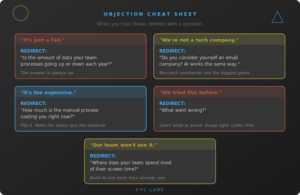
When you hear these, here’s how to redirect:

“It’s just a fad.” Ask them: “Is the amount of data your team processes going up or down each year?” The answer is always up. AI is how companies keep pace with growing data without growing headcount at the same rate. The trend line is the argument.

“We’re not a tech company.” Good. That means you’ll see a bigger impact. Tech companies have already optimized their operations. Companies that haven’t are sitting on the largest gains. Ask: “Do you consider yourself an email company? You use email every day. AI works the same way, it’s a tool for the work you already do.”

“It’s too expensive.” Flip it: “How much is the manual process costing you right now?” Then revisit the math from Step 2. The real question isn’t whether AI is expensive. It’s whether doing nothing is more expensive. (It usually is.)

“We tried something like this before and it didn’t work.” This is actually the most useful objection. Ask: “What went wrong?” You’ll learn exactly what to avoid. Usually the answer is that the previous project was too broad, too vague, or built by someone who didn’t understand their business. That’s precisely why a focused pilot with a team that listens matters.

“Our team won’t use it.” Fair concern. The fix is building the AI into tools the team already uses, not asking them to learn a new system. Ask: “Where does your team spend most of their screen time?” That’s where the AI should live.
 

pitch ai


The 60-Second Version


If you forget everything else, remember this sequence:

  1. Ask what task their team hates.
  2. Put a dollar amount on that pain.
  3. Show a boring, relatable example.
  4. Propose a small, low-risk test.
  5. Hand them the words to pitch it internally.

That’s the whole playbook. Five questions, five conversations, zero jargon.


Your client doesn’t need to believe in AI. They need to believe that the thing eating 10 hours of their team’s week can be fixed. You’re the person who shows them how.


FYC Labs builds custom AI solutions for companies that are ready to stop doing things the hard way. If your client has a process worth automating, let’s talk.


FYC Labs Expands Digital Product Offerings with Apple Mini-App Development Services

Apple Mini-App Development

El Dorado Hills, CA – February 10, 2026

FYC Labs is announcing the launch of its Apple Mini-App development services, effective February 10, 2026. The new service enables businesses to create lightweight, embedded app experiences within existing iOS applications– delivering functionality without the need to build or maintain full standalone apps.

Apple Mini-App development allows companies to deliver fast, focused features- like onboarding, commerce, payments, scheduling, and account management. These features run directly inside host apps while leveraging native iOS capabilities and Apple’s in-app purchase infrastructure.

“Mini-apps represent a meaningful shift in how products are built and distributed on iOS,” said Justin Fortier, CEO of FYC Labs. “They combine the speed and flexibility of the web with the performance and reliability of native apps. This approach is especially valuable for companies that want to move quickly without committing to a full app build.”

FYC Labs’ mini-app development services include:

  • Mini-app architecture and technical strategy
  • UX/UI design optimized for embedded iOS experiences
  • Apple-compliant payment and entitlement flows
  • Secure API and backend integrations
  • App Store and Apple review readiness support

This offering helps startups, SaaS platforms, and enterprises reduce time-to-market, test new features, and expand their products into iOS with lower costs and risk. Mini-app development is available as a standalone service or as part of FYC Labs’ broader suite of product, automation, and AI solutions.

Follow us on LinkedIn!

Turning a Chance Win Into a Strategic Upgrade: Govtech Ventures Gets the Digital Presence It Deserves

GovTech Ventures

Earlier this year at Folsom Tech Week, Rachel Stern won a free website build from FYC Labs. A prize she wasn’t expecting, but one that arrived at the right moment. After launching her firm, Govtech Ventures, a few years ago with a simple DIY GoDaddy site, she knew her online presence didn’t reflect the level of professionalism or clarity she had since developed. Her company had evolved; her website hadn’t. Winning the site gave her the push to elevate her brand into something that represented her growth.

Once the project kicked off, our team guided Rachel through a full redesign process- from understanding her refined value proposition to translating it into a polished, credible digital presence. FYC Labs’ design and development team partnered closely with Rachel, incorporating her vision and ensuring every detail aligned with the firm she’s building. 

“Kevin and Tim were great at going back, tweaking little things, and took a lot of my feedback. They were really good communicators and executed in a way that I think looks great.”

The final product is a website Rachel now feels genuinely proud to share. It gives prospective investors and partners a clear snapshot of who she is, what she’s building, and why it matters. The new website is polished, intentional, and aligned with the next stage of Govtech Ventures.

Check out the website here

Follow Govtech Ventures on LinkedIn

Fractal Group Announces Strategic Partnership with FirstGen Agency to Accelerate Brand Growth and Innovation

FirstGen Agency

Fractal Group, a technology consortium known for building, investing in, and scaling software and digital ventures, has announced a strategic partnership with FirstGen Agency (FGA), a boutique strategy firm founded by Raheel S. Malik. The collaboration brings together Fractal Group’s deep expertise in technology and venture growth with FGA’s proven ability to build, capture, and broadcast brand stories that drive measurable business outcomes.

FGA, led by Raheel S. Malik- a first-generation American and seasoned strategist with over 15 years of experience leading technology sales, go-to-market strategy, and startup acceleration- has helped founders and executives across North America launch, scale, and win. Through its “Build/Capture/Broadcast” methodology, FGA delivers end-to-end solutions in brand strategy, creative design, web development, media production, and digital marketing.


“Fractal Group was built to bring together the best of innovation, execution, and scale. Partnering with Raheel to create FirstGen Agency 2.0 adds yet another strategic dimension to how we help companies grow. It’s not just about technology- it’s about connecting going to market with vision, voice, and execution.”

“This partnership represents the kind of collaboration that drives business growth. By combining storytelling with systems thinking, we’re helping companies build stronger, more scalable brands.”


This partnership empowers both teams to deliver a full-stack growth ecosystem for founders, executives, and emerging ventures- combining Fractal Group’s technology, capital, and operational expertise with FGA’s creative and storytelling capabilities. Together, they’ll help brands not only define their voice but also scale their impact across digital platforms.


“At FGA, we’ve always believed that great brands are built at the intersection of clarity and execution. Partnering with Fractal Group allows us to scale that belief with the resources and reach of a world-class tech ecosystem. Together, we’re giving our clients the tools to build, capture, and broadcast their story like never before.”


With this collaboration, Fractal Group and FirstGen Agency are setting a new standard for how technology, creativity, and strategic execution converge to help businesses thrive in the digital age.


About Fractal Group

Fractal Group is a consortium of technology companies and startups specializing in software development, fintech, cybersecurity, and venture growth. Founded by Justin Fortier and Graham Peck, the group supports founders and innovators with shared resources, investment frameworks, and operational excellence to accelerate success. Learn more here.

About FirstGen Agency (FGA)

Founded by Raheel S. Malik, FirstGen Agency is a boutique strategy agency that helps founders and executives transform vision into execution. Through its “Build/Capture/Broadcast” model, FGA delivers brand, media, and growth strategies designed to help companies launch, scale, and dominate. Learn more here.

Fractal Group Partners with Break Thirty to Power Next-Level Growth

Break Thirty

Fractal Group is teaming up with Break Thirty in a strategic partnership to strengthen the performance of its internal brands with high-level digital marketing that delivers real results. While Fractal’s ventures thrive on efficient systems, innovation, and strategic investments, Break Thirty brings deep expertise in Shopify development, conversion rate optimization, SEO, and full-funnel marketing. This collaboration ensures Fractal’s ventures benefit from optimized, high-impact marketing infrastructure- automating growth and strengthening brand equity from within. By integrating Break Thirty’s growth-driven marketing with Fractal’s operational capabilities, the partnership boosts performance and positions internal brands for long-term success.

“Partnering with Break Thirty aligns perfectly with our mission to leverage strategic capabilities for greater impact. By integrating their expertise in digital marketing and optimization with Fractal Group’s innovative operational systems, we’re set to drive growth and boost our competitive edge. We are committed to building resilient, forward-thinking brands. Together with Break Thirty, we aim to not only meet our objectives but redefine success.”

“I’m excited to partner with Fractal Group and support their ventures through Break Thirty’s performance marketing strategies. Their belief that lasting success is built from small, consistent efforts resonates strongly with how I approach growth. Together, we look forward to amplifying impact and creating meaningful results across online services, DTC brands, and digital communities.”

About Fractal Group

Fractal Group is a collaborative venture studio of entrepreneurs and innovators who believe– and prove- that “big successes come from countless tiny efforts.” Leveraging efficient systems, the group powers both service businesses and groundbreaking tech ventures while driving growth through strategic angel investments. Its portfolio includes FYC Labs, Accru, DealSend, Highland Principals, Attaq Vector, and more. This values-driven network blends innovation with operational excellence and a dedicated community. They position Fractal Group as a unique growth engine for next-generation software and service companies.


About Break Thirty

Break Thirty is a results-driven digital agency dedicated to helping brands break through the noise and achieve measurable growth. We work closely with our clients to uncover opportunities, optimize campaigns, and maximize ROI. Whether you’re a startup looking to scale or an established brand aiming for a digital transformation, we have the expertise to take your business to the next level. 

Visit their website

Introducing Our Partner – Granite City

Granite City Coworking

At FYC Labs, we value partnerships that align with our commitment to community growth and innovation. We are introducing our partner Granite City- a coworking space that shares our mission of fostering collaboration and supporting local businesses. Granite City provides more than just workspace; it creates an environment where professionals can thrive together, helping the local business community grow.

Granite City opened doors back in 2019 in Folsom, California. Since then, it has been more than just a place to work from; it turned into a thriving community of professionals who value collaboration, flexibility, and support. Granite City’s environment is designed to foster growth, allowing individuals and businesses to flourish. Whether you’re looking for coworking spaces or private offices, they offer solutions tailored to meet your productivity needs. With a quiet, distraction-free atmosphere, you can focus on your work without the interruptions that often come with working from home.

Beyond office spaces, Granite City provides dynamic meeting rooms for important calls, virtual meetings, or in-person discussions, giving you the flexibility to conduct business your way. Additionally, their event spaces are perfect for a wide range of occasions, from corporate retreats to weddings and celebrations. 

Granite City is committed to providing exceptional spaces and services that meet the evolving needs of today’s professionals. We encourage you to explore their website if you want to learn more and to be part of a community where growth and support go hand in hand! Stay tuned to our blog for more highlights of our amazing partners and the work we do together.


Check out more of our partners here!

Connect With Us!